
I’ve watched the new Netflix documentary ‘Trust Me: The False Prophet’ and it got me thinking about the wider phenomenon of ‘father cults’ and my own personal experiences with it.
In a way, the documentary reminds me of my own childhood, and how child sexual abuse can become normalised within a family where the father’s role is centralised and elevated to an authority figure demanding blind obedience.
When I finished watching the documentary yesterday, I then watched another video featuring historian Antony Cummins, in which he once again criticised the martial art that I, in my youth, felt almost magically drawn to.
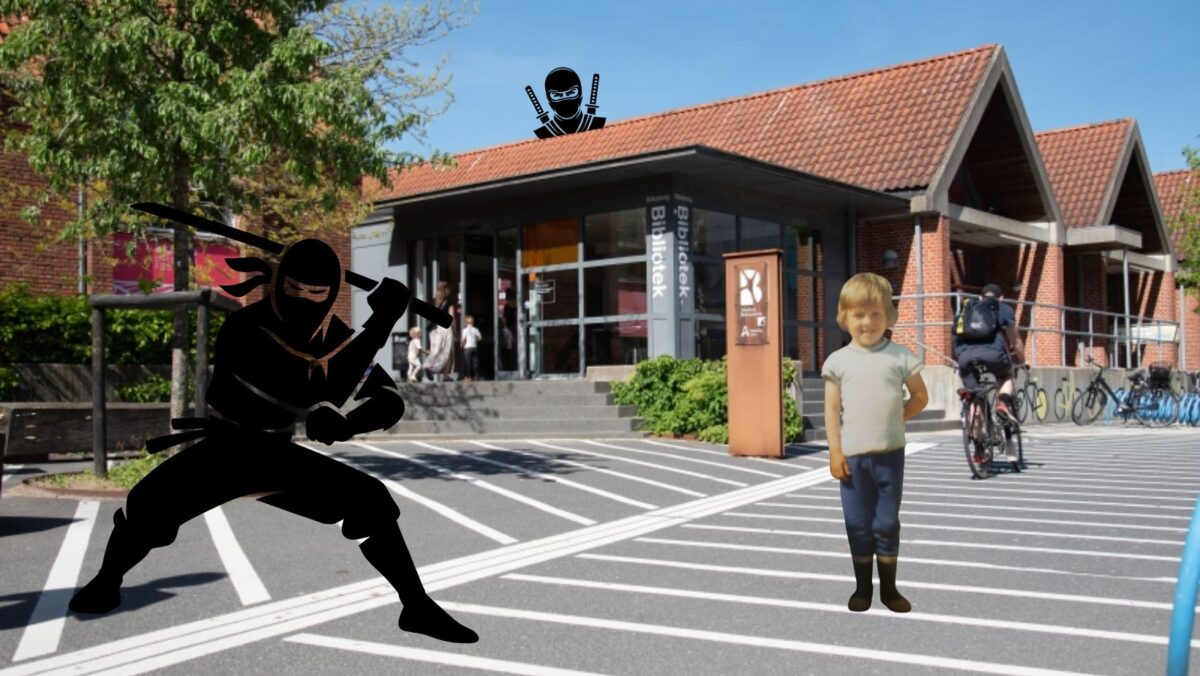
As a teenager, I escaped into the world of books at Silkeborg Library, and I found a particularly soothing refuge in Stephen K. Hayes’s Ninja books. Both as a young person and as an adult, I also went around trying out proper ninja training with various instructors. My best experience was with a teacher in Sorø, when I lived there in the 1990s, as he combined ninja training with kickboxing, using protective gear and full-contact sparring. It was fun, and it helped me let off some steam.
Looking back, it is clear to me that I saw Stephen K. Hayes as the father I never had. With just the right combination of strength and wisdom. It is also clear to me that my fascination with martial arts (I trained in many different systems) and with weapons (as a rather young child, I often carried a dagger in my belt) was also down to the fact that, from the age of 5 or 6 onwards, I felt chronically threatened, so I needed to be able to defend myself.
Stephen K. Hayes’s teacher is Masaaki Hatsumi, and since he was made world-famous and popular by Hayes’s best-selling books, what I and others perceive as a cult of personality has arisen around him. Or, more specifically, a father cult of adult children (especially boys) who, in their longing for a good father figure, have submitted to Soke Hatsumi as the one they follow blindly – combined with romantic illusions of combat, war and violence.
The problem is simply that both the prophet in the Netflix documentary and Masaaki Hatsumi are charlatans – in very different fields, admittedly, but with the total absence of critical thinking among their followers as a common trait. According to historian Antony Cummins and others who have actually researched the subject, there is in fact no such thing as a specific ninja martial art. There is simply no historical evidence for the claims on which Masaaki Hatsumi’s popular and global Bujinkan school is based. It is something Hatsumi himself has invented, inspired by popular fictional films about ninjas and, of course, by the real Japanese martial arts tradition which, when it comes to unarmed close combat, simply does not include any special ninja tricks at all. The same tricks were taught and used by all samurai.
Stephen K. Hayes broke away from his teacher to establish his own system, in protest against what he perceived as outdated techniques that are ineffective against modern threats. However, he has not abandoned the myth of the ninja, as his entire business empire, much like Hatsumi’s, is based on it. Hayes became intensely unpopular amongst the many who remained in the ‘Hatsumi-as-father’ cult (Bujinkan). The reactions are reminiscent of those one encounters when leaving a religious cult. Hayes has, perhaps, created his own cult instead. In any case, I still have fatherly feelings for him, even though I have never met him.
Both Hayes and Cummins are adept at articulating the same criticism that I, too, have of Bujinkan training. You become very good at defending yourself against attacks you will never encounter in the real world in today’s society (unless you are attacked by another Bujinkan practitioner). On the other hand, you never learn to defend yourself in the chaos of a real-life attack, as the training takes the form of play, role-play and a focus on intricate, acrobatic techniques rather than what actually works in the heat of battle.
In my opinion, Bujinkan is a personality-worshipping father cult disguised as a traditional Japanese martial art, where obedient disciples are taught a romanticised, unrealistic approach to self-defence. The result is that when disciples are attacked on the street, they are so paralysed by shock that they are unable to defend themselves in the face of the raw, undisciplined brutality of violence. The illusion of strength is easy to maintain as long as you aren’t actually attacked, and in that peaceful state you can rejoice that you have finally found the father you longed for as a child. Whilst wasting one’s time and energy, and it was precisely that sense of waste that meant I never stuck with the training for very long at a time.
That said, there are clearly many Bujinkan practitioners who are good at fighting. This makes me think more broadly about what it actually means to be good at fighting and defending oneself in Denmark today. Many of the basic techniques in Bujinkan and many other forms of martial arts and combat sports carry the risk of landing you in prison if you use them against a real attacker on the street. How much martial art and self-defence is there in that, if you end up in prison for defending yourself?
A modern martial art must adapt to both the physical threats and the legal threats that arise from defending oneself. In Denmark, the law is such that if you are punched in the face and hit over the head with a bottle, and then strike back at the person who attacked you, both the attacker and the defender will be charged with assault. Striking back is not considered self-defence, and virtually all forms of martial arts are based on striking back to stop the attack.
A couple of years ago, I met a man who told me that he had recently been attacked by three men in Rådhuspladsen, and when he defended himself by knocking them to the ground, he was sentenced to three months in prison. The punishment is harsher if you are trained in close combat and therefore ought to know what you are doing. But you are trained in something that, in a self-defence situation, instantly puts you on the wrong side of the law. This fine line between self-defence and violence means that most of what you learn in Bujinkan, karate, MMA, etc. is illegal to use in practice. Realistic, effective and safe self-defence is therefore something quite different for private citizens these days.
Related:
Du skal være logget ind for at vurdere dette indlæg.
Discover more from Via Brændgaard
Subscribe to get the latest posts sent to your email.